Isolation Module
The isolation module of the SUIT toolbox uses a pre-trained convolutional neural network to isolate the cerebellum and brainstem from the rest of the head. The network was trained on manually labelled anatomical images from a wide range of studies, scanners and acquisition protocols. It works more reliably and accurately than previous (Matlab) versions of the SUIT toolbox. The network is based on the U-Net architecture. The network was developed by Yao Li with supervision from Carlos Hernandez-Castillo and Jörn Diedrichsen.
You can directly import the isolate function from the SUITpy package and use in python code (recommended)
Use isolate from terminal or bash script
You can run the script directly via the terminal or bash script.
python isolate.py --T1 T1w_image
The optional input parameters are
--T1: T1w- image
--T2: Additional (or standalone) T2w image
--brain_mask: Binary mask image from skull stripping step to improve registration (optional)
--label: path to label image (reserved, currently has no effect)
--result_folder: Folder to save the results (default: input images base foder)
--template: Template for registration
--type_of_transform: reserved for future use (see ANTspy)
--max_iterations: maximum number of registration iterations (optional, default 5)
--params: pretrained parameter file
--save_cropped_files: whether to save files cropped to UNet input window
--use_q_form: whether to use q-form
--verbose: whether to print out status information during processing
Architecture
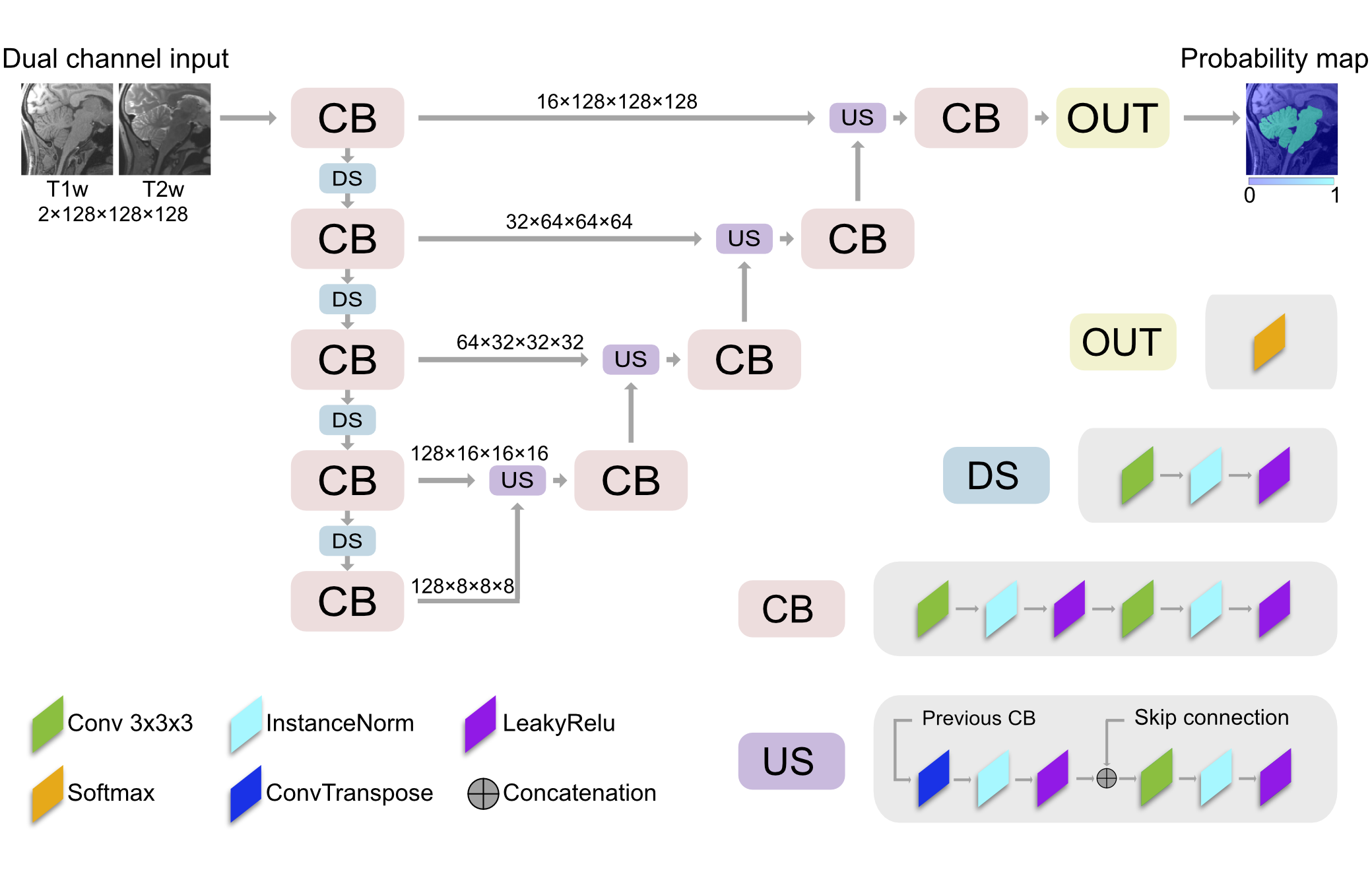
The model then has a classic U-Net architecture with 4 layers depth. It takes 2 input channels which are filled with T1w and T2w images respectively. 0 padding is used if any input channel is empty. The model works well on any single modality input (T1w/T2w) and has better performance when both modalities are provided. If T1w and T2w images are fed, two images must be co-registered to each other.